
%20(1).png)
Why Choose AI Sales Training Software
Sales training can sound convivial until the costs are considered: freshers take about 4-6 months to reach full productivity, which costs companies $2,000 per person in lost revenue. Not only that, the top sales reps of the company spend 15-20 hours per new sales rep on role-playing sessions, coaching, and mentorship, time they could be investing in closing more deals. And having a dedicated sales training team is not worth the money.
That is precisely why the use of AI is increasing. AI-driven sales training tools commonly help companies cut training time and costs by 50–70%, allowing sales teams to focus on closing more deals. This frees up your sales team to focus on revenue generation rather than on training. AI sales training software makes training efficient and realistic. Through role-playing sessions, performance evaluations, and feedback mechanisms, it helps trainees work on their weaknesses and identify their strengths without any human intervention
What Does the Training Process Look Like?
The training process consists of 6 major steps, and here is how businesses can use it to benefit them in 2026.
Step 1. Data Feeding
The sales training software is fed every detail about your company. It reads your product documents, sales scripts, and FAQs. It can also listen to recordings to understand the needs of the business. All of this data feeding helps the AI to understand your service and the soul of your business. As a result, it can replicate practices that have proven to work well for your company rather than relying on generic practices that may or may not suit your business model.
Step 2. Curriculum Creation
An AI model needs to be told about the specifics of your business that shape your service, the key areas that your customers usually fixate upon, and the related information that your salespeople must know in order to make the sale. This helps the virtual coach to understand what is to be taught. You can help it by setting up situations that you want the trainees to practise; they can be cold calls, queries about the product, complaint responses, or anything. When you specify what you want, the AI will deliver according to your specifications.
Step 3. Role-playing
Role-playing is one of the easiest ways to learn; it is fun and prepares the trainees for real-life client calls. So, an AI role-play sales training software sets up a role-playing scenario using the data fed to it earlier. It simulates real conversations with clients where it acts like a real customer with varied moods, questions, mindsets, and objections. This introduces the trainee to every possible scenario during a real client conversation. Trainees practice over a hundred scenarios before taking on a real client call, without the involvement of a senior sales rep.
Step 4. Active Listening, Understanding, and Evaluating
An AI sales training software uses advanced technology like Natural Language Processing (NLP) and machine learning to understand tone, emotion, meaning, and intent in a conversation.
As the trainee responds to the questions asked by the virtual sales coach, it listens, responds, and answers back to keep the conversation going. In the process, it analyzes the tone, confidence level, response time, and their way of handling a situation, which are crucial aspects when pitching a client.
Step 5. Personalized Feedback and Practice Exercises
AI sales training software generates an instant performance report highlighting the strengths and weaknesses of the trainee. “You take 8 seconds too long to answer pricing questions,” or “Your confidence level drops by 30% when competitors are mentioned.” With insights like these, it underlines the places that need improvement and suggests a customized practice routine that can help the trainee effectively work on their weak spots.
Step 6. Performance Reporting and Tracking
The progress reports of each trainee are shared on the manager’s dashboard with readiness scores and risk flags. Managers can be in a constant loop on the performance report of each trainee and can figure out who is struggling early on. This helps them notice the gaps and fix things accordingly.
By undertaking all these steps, AI sales training software hones sales individuals who perform. By automating and personalizing tasks that otherwise require a lot of repetitive effort and still produce generalized results it ensures efficient training.
Impact on Businesses
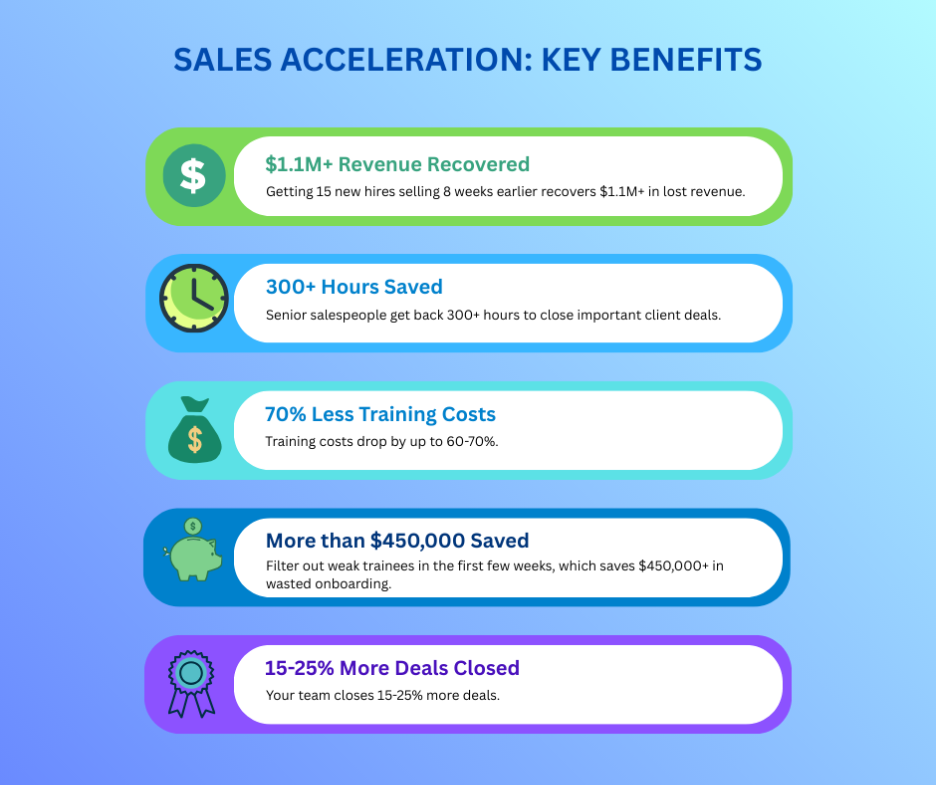
Sales training software automates tasks that otherwise require repetitive effort from your seasoned salespeople and can provide better results. For a 50-person sales team with 30% annual turnover, the metrics could look something like this.
- Getting 15 new hires selling 8 weeks earlier recovers $1.1M+ in lost revenue
- Senior salespersons get back 300+ hours to close important client deals
- Training costs drop by 50-70%
- Filter out weak trainees in the first few weeks, which saves $450,000+ in wasted onboarding
- Your team closes 15-25% more deals
As a result, companies that choose AI sales training software save $100,000 to $200,000+ while growing faster.
Final Thoughts
With AI sales training software, ROI can be delivered through four mechanisms:
- cutting the ramp-up time by half
- freeing trained professionals to focus on clients rather than trainees
- Reducing direct training costs by 70%
- helping identify gaps at early stages
As we enter 2026, we are sure to encounter tougher competition and higher customer expectations, which will require sales teams to perform faster, smarter, and with greater focus. Many companies have shifted to an AI sales training model, which has helped them grow more efficiently with less friction


.png)